Reintroducing Lorenzo Protocol: A New Foundation for Real Yield In On-chain Finance
Lorenzo Protocol began by helping BTC holders access flexible yield through liquid staking tokens. Along the way, we integrated with 30+…


Lorenzo Protocol began by helping BTC holders access flexible yield through liquid staking tokens. Along the way, we integrated with 30+ protocols, supported over $650M (at peak) in BTC deposits, and built a trusted yield network across 20+ blockchains.
Now, following our successful IDO on Binance Wallet, we’re not pausing.
After months of development, we’re unveiling the Financial Abstraction Layer, a strategic upgrade to strengthen our core infrastructure and accelerate the next phase of growth. This marks a shift toward a long-term, sustainable business model focused on delivering real yield and institutional-grade solutions through tokenized financial products.
View our new website: https://lorenzo-protocol.xyz/
Let’s walk through the new Lorenzo, including the reasoning behind this direction, high-level details of the Financial Abstraction Layer, and a preview of our product models, architecture, and value proposition.
The Opportunity: Yield Is The Missing Layer
Through the revolutionary advancements of stablecoins and the Payment Finance industry sector, a multi-trillion-dollar on-chain payment ecosystem has emerged, transacting over $5 trillion in adjusted volume in 2024 while the growth of the global payments market — projected to reach $5.3 trillion by 2030 — will continue to fuel the influx of capital into DeFi ecosystems.
Institutional adoption of stablecoins also surged in 2024:
- Stablecoin Market Capitalization: Grew by 57% in 2024, from $130 billion to $204 billion.
- Stablecoin Transfer Volume: Increased by 148%, from $1 trillion to $2.6 trillion monthly.
- Transaction Volume: By Q2 2024, stablecoin transactions had surpassed Visa’s total transaction volume.
Based on these current trends, experts predict that, by 2030, the stablecoin supply could account for 10% of the M2 money supply in the U.S. — a massive increase from the current 1%.
However, despite the significant advantages that stablecoins hold over traditional banking, three key problems remain:
1. DeFi still lacks sustainable, real yield.
Most returns rely on unsustainable short-term incentives rather than risk-managed financial products, limiting institutional adoption.
2. Financial demand can’t be fully met by pure DeFi protocols
Over $242.80 billion in stablecoins circulate on-chain, but much of it sits idle, especially within CEXs, wallets, and card issuers. These platforms lack modular, compliant backends to deploy capital into yield strategies.
3. Platforms need plug-and-play yield solutions.
On-chain financial access platforms — neobanks, wallets, PayFi apps, and lending protocols — are scaling fast. These platforms need tokenized yield solutions that can be user-facing and composable for diverse integrations.
Together, these conditions have created a golden moment for the needed yield infrastructure to be created and scaled.
Lorenzo is building to meet this demand.
The New Lorenzo
Lorenzo has upgraded into an institutional-grade on-chain asset management platform, focused on tokenizing CeFi financial products and integrating them with DeFi. At its core is the Financial Abstraction Layer, an infrastructure layer delivering composable and verifiable yield modules for financial access platforms like neobanks, PayFi apps, wallets, RWA platforms, and DeFAI projects.
Lorenzo can be seen as an on-chain investment bank: on one side, it sources capital (BTC, stablecoins); on the other, it connects to yield strategies (staking, arbitrage, quant trading), packaging them into standardized yield products for easy integration by wallets, PayFi apps, or RWA platforms. Think of it as a modular financial issuance layer — projects can plug into Lorenzo’s vault system to launch yield products, while users earn passively by allocating funds through integrated apps and receiving yield tokens that capture platform upside.
Lorenzo is also working to
The Financial Abstraction Layer: An Overview
Real yield should be accessible to everyone and easily connected.
The Financial Abstraction Layer makes CeFi strategies usable on-chain by packaging custody, lending, and trading into simple tokens accessible via standardized vaults and modular APIs. This system makes real yield a native feature of on-chain financial flows such as payments, deposits, and transfers.
The Financial Abstraction Layer benefits:
Institutions and platforms
Wallets, payment apps, RWA platforms, and card issuers gain modular access to customized financial structuring, yield strategies, settlement rails, and security frameworks. They can launch yield products without building financial logic or managing assets.
Developers and yield strategy providers
Quant funds, RWA issuers, and DeFi protocols can tokenize and distribute their strategies through Lorenzo, increasing assets under management and broadening accessibility.
PayFi Projects
Idle assets like stablecoin reserves or crypto card collateral can be deployed into high-yield vaults, turning passive balances into monetized flows.
Users
Users earn verifiable returns as a native feature of their interactions with partner apps. No active management is required. Through staking, referrals, and missions, community participants can also earn long-term upside by holding yield tokens and engaging with the ecosystem.
Supported Product Models
Lorenzo supports a flexible set of product models that allow institutions to integrate yield infrastructure like a backend service:
1. Vault Issuance Model
Simple Vaults Simple Vaults are on-chain wrappers for individual strategies like BTC staking, delta-neutral trading, or RWA hedging.
Composed Vaults Composed Vaults are multi-strategy portfolios, comprising several Simple Vaults. They are rebalanced by third-party agents (individuals, institutions, or AI managers).
2. Modular APIs
APIs and modular kits enable wallets, PayFi apps, or card platforms to plug into Lorenzo’s vault system and offer embedded yield to users.
3. On-Chain Traded Fund (OTF)
OTFs package abstracted yield strategies, such as fixed yield, principal protection, and dynamic leverage, into tokenized financial products, accessible through a single tradable ticker.
For centralized financial strategies like quant funds, credit portfolios, or market-making operations, OTFs offer a structured path to:
- On-chain fundraising
- Off-chain execution
- On-chain settlement
Each product is tokenized within an underlying vault. These vaults are composable across DeFi and mint the OTF’s tokens upon purchase.
The goal of OTFs is to democratize access to sophisticated trading strategies, much like ETFs have done in traditional finance.
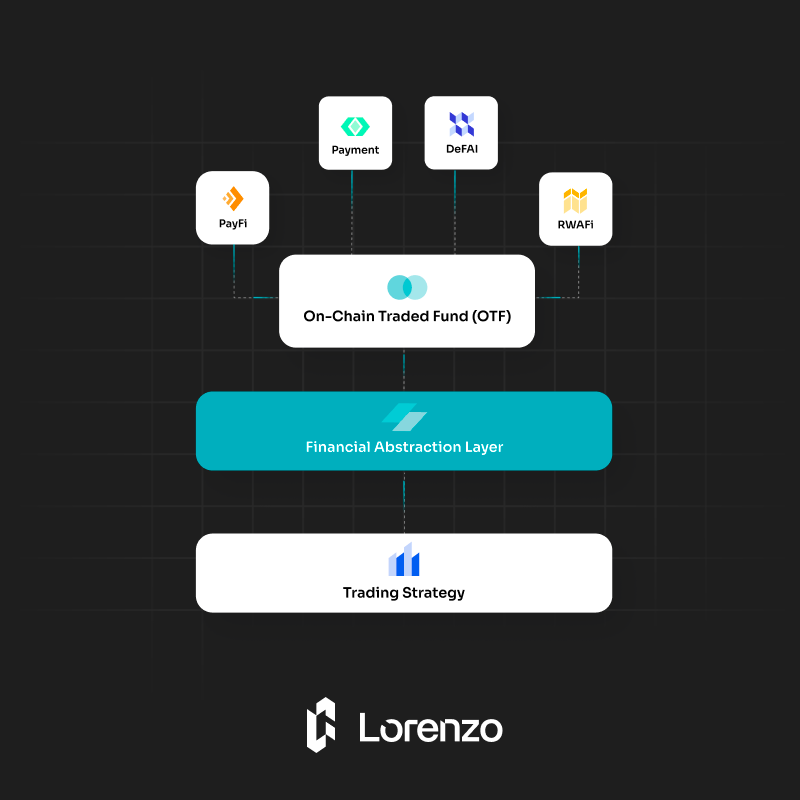
System Architecture
- Trading Strategies Yield is generated from various CeFi sources targeting different risk/return profiles: staking, arbitrage, and quant trading
- Financial Abstraction Layer Raw strategies are transformed into vault-ready, standardized components that can be tokenized
- On-Chain Traded Fund (OTF) Tokenized yield strategies (e.g., fixed yield, principal protection, and dynamic leverage) are made accessible to everyday users through a single tradable ticker, similar to ETFs in traditional finance.
Example Use Cases
PayFi Products
Card issuers or wallets that hold BTC or stablecoins as collateral can deploy that idle capital into vaults, reducing costs, increasing capital efficiency, and optionally redistributing yield to users.
RWA
Lorenzo vaults can stake low-yield RWA tokens, extract stablecoins via CDPs, CEXs, or prime brokers, and redeploy them into higher-yield strategies, effectively doubling returns.
DeFAI
DeFAI agents can use Lorenzo vaults as pre-built strategy layers to manage diversified portfolios, like hedge funds, without needing to build their own infrastructure.
Exchanges
Exchanges offering “earn” accounts face growing pressure to differentiate and generate returns for users. By integrating with Lorenzo, they can plug idle balances into yield vaults without taking on execution or custody risks, offering verifiable, composable yield products with institutional-grade logic.
Why Work with Lorenzo
Lorenzo isn’t just a yield engine — it’s a partner in building the next generation of programmable finance. We combine institutional-grade infrastructure with a full-stack service model that simplifies yield deployment for any platform.
Our professional quant team designs and manages risk-adjusted strategies tailored for diverse financial goals. For partners, this means accessing real yield strategies without having to build or operate them. Lorenzo handles the entire backend: from custody and execution to strategy optimization and payout.
In addition to technical tooling, we offer operational support for managing on-chain yield flows, robust compensation mechanisms for risk management, and optional BANK token incentives to align long-term partner growth with ecosystem rewards.
Whether you’re a wallet, RWA issuer, or crypto card platform, Lorenzo empowers you to turn idle balances into composable, verifiable yield products at scale.
What’s Next
Lorenzo is laying the foundation for a global financial network where real yield is embedded in every transaction. With support from early partners, we are launching tokenized financial products that span BTC staking, quant trading, and RWAs.
Stay tuned for future updates on new tokenized product releases.
The era of real yield has arrived. Lorenzo is where it begins.
If you enjoyed this blog, share it with a friend and invite them to the Lorenzo community!
To stay informed on all Lorenzo staking updates and opportunities, please visit and follow the regular updates on X (Twitter), Medium, Telegram, and Discord.