sUSD1+ OTF's Market Timing: RWA Growth, Regulatory Clarity, And More
ETF growth, tokenized real-world assets, DeFi vault adoption, and new U.S. crypto regulation are converging to enable on-chain traded funds (OTFs). This article explains why the market is now ready for compliant, yield-bearing tokenized funds like sUSD1+ OTF.

Over the past several years, the growth of Exchange-Traded Funds (ETFs) and on-chain real-world assets (RWAs), as well as the maturation of DeFi yield and revamped U.S. regulatory clarity, have created the optimal environment to launch tokenized funds on-chain as On-Chain Traded Funds (OTFs).
This product category, developed by our team at Lorenzo Protocol as a flagship for our on-chain investment bank, is inspired by certain ETF features but designed for programmable money. By bridging regulatory clarity, deepening liquidity, and shifting capital flows, the environment for these products, like sUSD1+ OTF, is becoming more favorable than ever.
In this article, we'll examine the current market context and the key elements of today’s financial environment that are favorable to OTFs and to Lorenzo Protocol.
ETF Growth And Its Relevance to On-Chain Fund Innovation
ETFs have become one of the most successful financial innovations of the past three decades, offering diversification, liquidity, and cost-efficiency in a simple wrapper. Across geographies and asset classes, they have attracted trillions in capital by delivering a trusted format for both retail and institutional investors.
While some features of ETFs inspire their design, OTFs are a fundamentally different product category, built for programmable money and real-time finance, where assets interact with other on-chain protocols and operate without the time or geographic restrictions of traditional markets.
Unprecedented Scale And Momentum
By the end of 2024, global ETF assets under management (AUM) had reached $14.85 trillion, a 27.6% increase from 2023, driven by a record $1.88 trillion in net inflows. To put that in perspective, ETFs now surpass the hedge fund industry by roughly $10.3 trillion in assets, underscoring their dominance as a portfolio building block.
In the U.S., ETF adoption mirrored this trajectory, recording a record $1.1 trillion in net inflows in 2024. Competing to capture this demand, by the end of June 2025, 1,308 new ETFs had been launched, a 49% increase over the same period during the prior year.
The ETF market is also expanding in breadth to include thematic, fixed-income, and alternative strategy funds tailored to evolving investor preferences. This innovation cycle has introduced exposures ranging from state-specific equity baskets to private credit access for retail investors, illustrating how adaptable the ETF structure has become.
Highlighting that adaptability has been the emergence of actively managed ETFs as the fastest-growing segment (passive index strategies still dominate the ETF landscape), with 295 new ETFs launching in the first half of 2025 alone.
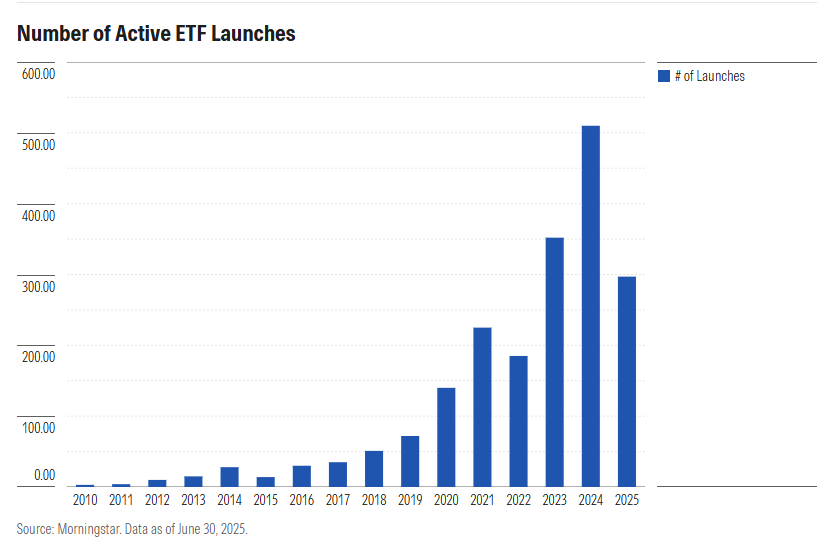
At the end of 2024, actively managed ETFs globally held $1.17 trillion in assets, up 58.6% year-over-year, according to ETFGI. By July 2025, that figure had grown to $1.48 trillion, marking the 63rd consecutive month of net inflows (ETFGI). Analysts at Deloitte project that U.S. active ETF assets could scale from $856 billion today to $11 trillion by 2035—a nearly 13-fold increase.
Why ETF Scale Matters For OTFs
For OTFs, the relevance of the ETF market is not about competition but about precedent. ETFs have proven that investors value diversified portfolios that can be traded easily.
And with active ETFs continuing their growth spurt, OTFs are designed to capitalize on that same investor favorability, providing passive yield to participants through strategies managed actively by quantitative trading teams.
Tokenized Real-World Assets: From Niche To A Multi-Billion-Dollar Building Block
RWAs are no longer a side quest in crypto—they're the connective tissue between traditional balance sheets and programmable markets. As of September 25, 2025, total tokenized RWAs tracked on public chains stood at around $30 billion, with more than 220 asset issuers and 400,000+ asset holders according to the live dashboard at RWA.xyz.
Dollars, Bills, Gold: An Increasingly Diverse Stack
In its mid-2025 review, CoinGecko’s “RWA Report 2025” estimates fiat-backed stablecoins (the largest RWA component) climbed +$97B from 2024 to April 2025 to an all-time high of $224.9B, with USDT and USDC driving the lion’s share (newer entrants like USDtb and USD0 gained early traction).
But RWAs today are not monolithic.
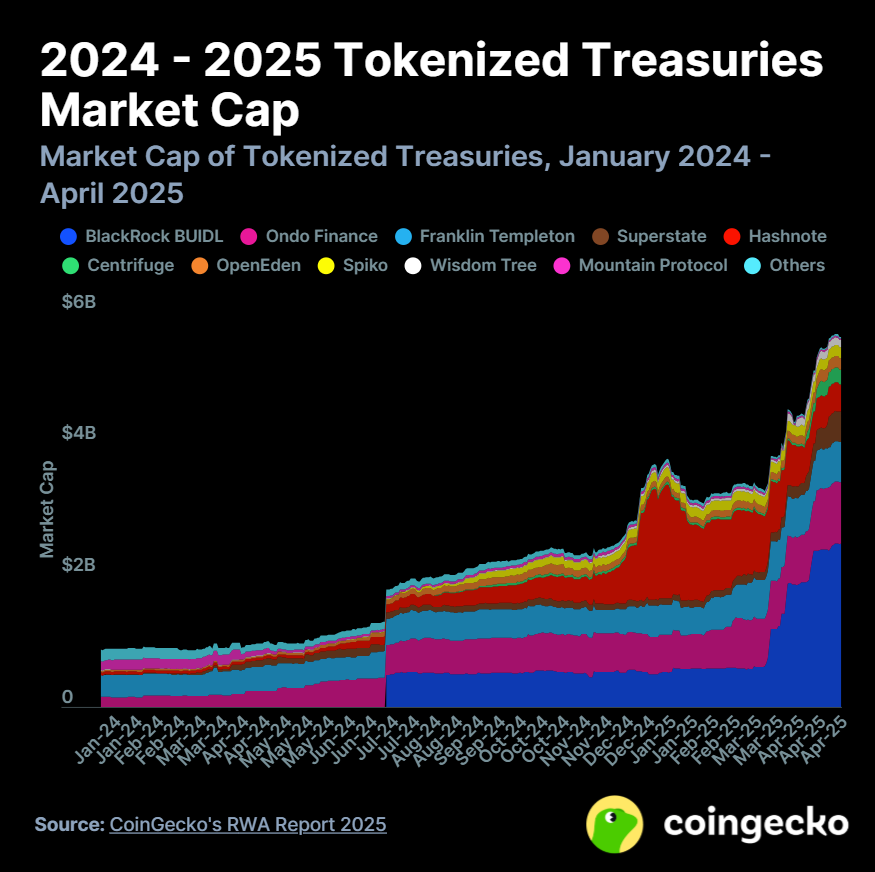
The same report highlights tokenized U.S. Treasuries as the fastest-growing sub-sector, up 544.8% since the start of 2024 to approximately $5.6 billion by April 2025, with BlackRock’s BUIDL (issued via Securitize) capturing a roughly 44–45% share at that snapshot. Commodity-backed tokens, led by gold proxies such as XAUT and PAXG, rose ~68% to ~$1.9B over the period.
The momentum is not purely headline-driven; macro and rate dynamics are doing real legwork. When U.S. trade tensions and risk-off positioning spiked in March/April 2025, tokenized Treasuries surged to a record as on-chain investors rotated toward short-duration, dollar-linked yield.
Further diversifying the RWA landscape is the new frontier of tokenized stocks and ETFs. On June 30, 2025, Backed Finance launched xStocks, bringing 60+ tokenized U.S. equities/ETFs to market via a coordinated rollout on Kraken, Bybit, and Solana DeFi rails. xStocks feature 24/7 trading, near-instant on-chain settlement, and integrations with Raydium, Jupiter, Kamino, and other DeFi protocols.
Crucially, these aren’t just exchange novelties; they are beginning to live inside DeFi as composable assets. Kamino became the first major DeFi lender to accept xStocks as collateral on Kamino Lend, allowing users to borrow stablecoins against positions like SPYx, QQQx, AAPLx, TSLAx, and others, as detailed in Kamino’s governance post.
Robinhood’s RWA Play
The tokenized-equity story isn’t confined to xStocks. On June 30, 2025, Robinhood announced stock and ETF tokens for EU customers, alongside plans for a Layer-2 chain optimized for RWA tokenization. Robinhood’s catalog includes 200+ names and (controversially) tokens referencing private companies like OpenAI and SpaceX via SPV structures—expanding access while inviting scrutiny.
Robinhood’s entry into the space signals a pivotal convergence of institutional-grade infrastructure with direct retail accessibility.
By bridging its established brokerage brand with blockchain-based distribution, Robinhood positions RWA tokenization for broader adoption, offering both credibility to institutional observers and a familiar on-ramp for everyday investors.
OTFs As A Bridge To RWA Yields
The growth of RWAs isn’t just an interesting market trend; it’s the reason OTFs make sense now.
For stablecoin holders, RWAs open an entirely new category of yield opportunities. This isn’t about putting “stocks on a blockchain,” but about creating programmable, on-chain fund structures that integrate yield-bearing assets alongside native DeFi strategies.
sUSD1+ OTF is built for exactly this environment. As tokenized short-duration Treasuries, money market funds, and other regulated instruments scale, they provide reliable building blocks for on-chain portfolio construction, delivering more sustainable and predictable yields than most of what’s been available in DeFi.
As the pool of tokenized, auditable assets grows, OTFs will gain more high-quality inputs, enabling portfolios that combine stability, yield, and programmability in ways that simply weren’t possible a few years ago.
DeFi Vault Growth And The Shifting User Profile
With RWAs broadening the investable universe, DeFi vaults are where much of that liquidity is being actively deployed. Vault strategies—ranging from conservative, delta-neutral stategies employed by teams like ours at Lorenzo to leveraged staking and cross-margin yield loops—have become a core operating system for on-chain capital.
For historical context, by late July 2025, DeFi TVL hit a three-year high around $153B, reversing the 2022–2023 contraction through renewed demand for on-chain yield. As of this week, DeFiLlama’s live dashboard shows sector TVL hovering around the $150B range.
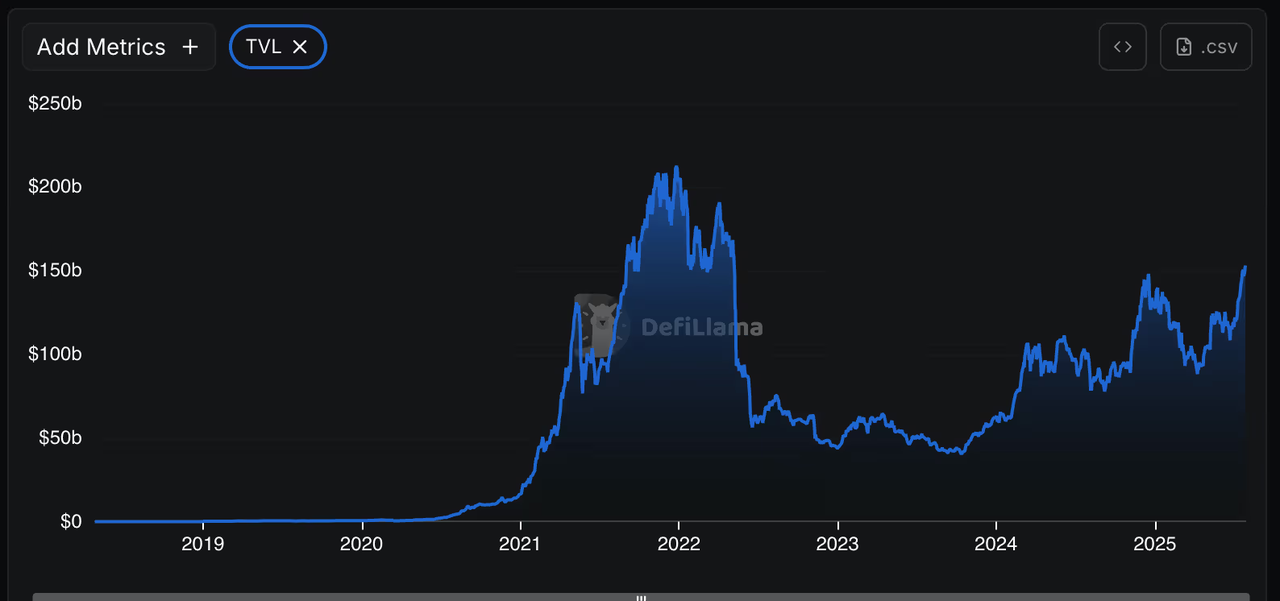
Within that resurgence, vault-powered lending protocols and yield platforms have been notable share gainers. On Solana, Kamino ranks as the chain’s top lending venue by TVL (roughly $3B), reflecting how deposits flow into composable strategies that can layer LP fees, staking rewards, and protocol incentives. Aave remains the largest cross-chain lender and saw a sharp 40% July TVL jump.
And while much of vault activity has been traditionally USDT/USDC-focused, the newest wave of vaults increasingly integrates RWAs under the hood. Kamino, for example, launched looping strategies that allow USDC or USDT deposits to be rehypothecated through lending and borrowing, creating yields that blend on-chain lending spreads with any embedded RWA returns from underlying assets. With Kamino Multiply, users can deposit to earn ~162% max APY from the JLP/USDC strategy's 6.2x max multiplier, earn from market-agnostic reinsurance yield with the ONyc/USDG strategy (2.0x max multiplier, 28.96% max APY), and much more. A common theme among strategies is exposure to several tokens at once (for JLP Multiply, users are exposed to SOL, BTC, ETH, USDC, and USDT), as well as floating yield and borrowing rates.
A growing subset of these strategies are being marketed to risk-aware, yield-seeking users rather than speculative traders. This shift is visible in Kamino’s adoption curve, as well as in protocols like Ondo Finance, which channels stablecoin deposits into tokenized Treasuries and corporate bonds. The overlap between RWA-based yield sources and DeFi-native vault execution is becoming a defining feature of 2025.
Together, these venues act as liquidity hubs: users deposit into a single vault or lending market, and the protocol routes that capital across integrated strategies to produce a blended, programmatic yield stream.
A Changing User Profile: From Degens To Diversified Allocators
The identity of vault users has evolved in recent years. In 2021–2022, vaults were dominated by yield-seeking "degens" chasing triple-digit APRs through aggressive strategies.
Today, however, the landscape has changed. Many wallets now participate in multiple yield-bearing strategies—spanning stablecoins, liquid staking tokens (LSTs), and RWAs—with longer holding periods and more measured position turnover. This maturity is visible in industry data: DeFi’s total value locked in lending protocols—including platforms like Aave and Euler—has ballooned by ~60% in the past year, reaching nearly $60 billion, indicating a shift toward deeper, more stable participation.
Furthermore, institutions and fintech companies are embedding DeFi vaults behind user-friendly interfaces—removing the need for retail users to execute complex strategies themselves. This implies that users are accessing vault yield mechanics behind the scenes, contributing to the rise of wallets with diversified, multi-strategy exposure.
While wallet-level behavior segmentation into “degen” vs. “allocator” is not directly published, these indicators collectively point to a growing sophistication in vault participation, characterized by multi-asset exposure and strategic layering of yield paths.
Why This Matters For OTF Adoption
DeFi vault usage has paved the way for OTFs to thrive. As users have grown comfortable with the vault model—depositing assets, receiving a tokenized position, and letting yield accrue—OTFs can plug into familiar behaviors rather than reinvent them.
At the same time, DeFi integrations, custody flows, and liquidity rails have become easier and lower-friction now that vaults are mainstream, making OTF adoption more seamless for both users and platforms.
Regulatory Catalysts: GENIUS And CLARITY Paving The Way For sUSD1+ OTF
In 2025, the United States took two major steps toward building a coherent legal foundation for digital assets, creating conditions that could accelerate the adoption of tokenized products like sUSD1+ OTF. The GENIUS Act, now law, and the CLARITY Act together form a twin pillar of stability and definition for the industry.
The GENIUS Act: A Federal Baseline For Stablecoins
Signed into law on July 18, 2025, the Guiding and Establishing National Innovation for U.S. Stablecoins (GENUIS) Act establishes the first clear federal framework for dollar-backed stablecoins. It requires 1:1 reserve backing in cash or short-term U.S. Treasuries, annual audits for issuers with more than $50 billion in circulation, and creates a shared supervisory structure between federal and state regulators—removing much of the patchwork that previously hampered U.S. stablecoin issuance.
For sUSD1+ OTF, this framework directly impacts the product’s operational trust layer. All yields are denominated and settled in USD1, the stablecoin issued by World Liberty Financial. By aligning with GENIUS’s reserve and disclosure standards, USD1’s legal clarity strengthens its role as the settlement medium across Lorenzo’s fund products, reducing counterparty risk for both U.S. and Asia-Pacific institutions in our cross-border liquidity network. It also increases the likelihood that banks, payment processors, and enterprise platforms will integrate USD1 into their systems, broadening potential distribution rails for OTF tokens.
The CLARITY Act: Defining Market Roles For Digital Assets
Passed by the House on July 17, 2025, the Digital Asset Market CLARITY Act creates a functional split between the CFTC and SEC. The CFTC gains jurisdiction over “digital commodities” like sufficiently decentralized tokens, while the SEC retains oversight of tokens offered as investment contracts. The bill also introduces defined registration categories for Digital Commodity Exchanges, Brokers, and Dealers, along with capital and conduct standards. It offers a three-year safe harbor for DeFi projects to reach compliance and updates disclosure, custody, and audit requirements for tokenized products.
If enacted, CLARITY would give USD1+ OTF a clear regulatory home. Depending on the final language, the product could operate within a digital commodity framework if structured as a non-security tokenized fund, or under a hybrid model if its composition includes regulated securities.
In either case, the bill’s provisions on custody and exchange registration offer practical pathways for licensed intermediaries—from U.S. broker-dealers to Asia-based market makers—to handle OTF tokens compliantly. That opens the door for secondary trading, integration with regulated alternative trading systems, and potentially even listing on CFTC-registered venues under the agency’s new spot-crypto trading rules.
A Favorable Regulatory Environment For USD1+ OTF
Taken together, the GENIUS and CLARITY Acts could shift tokenized funds from operating in regulatory gray zones to functioning within defined, auditable, and institution-friendly regimes. For USD1+ OTF, that translates into:
- A settlement asset (USD1) that meets federal standards for backing, audits, and disclosures—removing key institutional barriers.
- Operational clarity on issuance, custody, and secondary trading—making it easier for cross-border participants to engage without conflicting compliance rules.
- Greater interoperability with regulated infrastructure, including ATS platforms and custodians, which could extend the reach of OTF tokens beyond crypto-native channels into broker-dealer networks.
Operating in both Eastern and Western markets, this clarity is a functional enabler for our team at Lorenzo. It allows sUSD1+ OTF to be designed, marketed, and distributed in ways that satisfy institutional risk committees in New York as readily as liquidity providers in APAC hubs like Singapore, reducing friction in the global flow of capital between traditional and on-chain markets.
By bridging these two worlds, Lorenzo Protocol expands the addressable market for on-chain yield far beyond regional silos.
A Converging Market Opportunity
Taken together, ETF and RWA growth, new U.S. policy clarity, and the mainstreaming of DeFi vaults create a market environment that is favorable for compliant, yield-bearing on-chain products. These trends reinforce one another, accelerating institutional adoption while making yield products more accessible to retail users.
This convergence is where Lorenzo Protocol operates. Within this environment, USD1+ OTF represents a new class of yield product—one that takes inspiration from certain ETF features but is designed from the ground up for programmable money and real-time settlement. Composable across DeFi, fintech, and institutional platforms, it meets the operational requirements of large allocators while remaining accessible to everyday users.
As regulatory clarity strengthens and capital flows adapt, the gap between undeployed liquidity and active, productive capital is set to narrow. Lorenzo Protocol’s role as an on-chain investment bank is to accelerate that shift, building the infrastructure and products that enable both sides of the market to meet in the middle.
FAQs
What are On-Chain Traded Funds (OTFs)?
OTFs are tokenized investment products designed for programmable, on-chain finance. They are inspired by some ETF features but are built for real-time settlement, composability with other on-chain protocols, and global, continuous access.
How are OTFs different from traditional ETFs?
Traditional ETFs operate with limited trading hours and delayed settlement. OTFs function on blockchain infrastructure, enabling real-time settlement and interaction with other on-chain assets and protocols without time or geographic restrictions.
Why is the ETF market relevant to OTFs?
The ETF market demonstrates strong investor demand for diversified, liquid fund structures. OTFs build on this precedent while adapting the model for programmable money and on-chain financial systems.
How large is the global ETF market?
By the end of 2024, global ETF assets under management reached $14.85 trillion, with $1.88 trillion in net inflows that year. U.S. ETFs alone saw $1.1 trillion in net inflows in 2024.
Why does ETF scale matter for OTFs?
ETF growth shows that investors favor diversified portfolios that are easy to trade. OTFs are designed to capture similar demand by offering passive yield through actively managed, on-chain strategies.
What are tokenized real-world assets (RWAs)?
RWAs are blockchain-based representations of traditional assets such as stablecoins, U.S. Treasuries, commodities like gold, and tokenized stocks and ETFs.
How large is the tokenized RWA market?
As of September 25, 2025, approximately $30 billion in RWAs were tracked on public blockchains, with more than 220 asset issuers and over 400,000 asset holders.
Which RWA categories are growing the fastest?
Tokenized U.S. Treasuries grew by 544.8% since early 2024 to around $5.6 billion by April 2025. Commodity-backed tokens such as gold increased to roughly $1.9 billion over the same period.
What role do RWAs play in OTFs?
RWAs provide regulated, yield-bearing assets that can be used as building blocks for on-chain portfolios, enabling more stable and predictable yield strategies for products like sUSD1+ OTF.
How are tokenized stocks and ETFs being used in DeFi?
Tokenized U.S. equities and ETFs launched by Backed Finance are tradable 24/7 and are accepted as collateral on Kamino Lend, allowing users to borrow stablecoins against assets like SPYx and QQQx.
What is Robinhood’s role in RWA tokenization?
Robinhood launched stock and ETF tokens for EU customers and announced plans for a Layer-2 chain optimized for RWA tokenization, offering access to more than 200 tokenized assets.
How do DeFi vaults support OTF adoption?
DeFi vaults route user deposits into diversified strategies that generate blended yields. This model aligns with how OTFs function, making adoption more seamless for users and platforms.
Has DeFi participation changed in recent years?
DeFi TVL reached around $153 billion by mid-2025, with lending protocols growing significantly. Users increasingly deploy capital into diversified, multi-asset strategies rather than short-term speculative positions.
What regulatory developments support OTFs?
The GENIUS Act established a federal framework for U.S. stablecoins, requiring 1:1 reserve backing and audits. The CLARITY Act defines regulatory roles for digital assets and introduces registration categories for exchanges, brokers, and dealers.
Why is USD1 important for sUSD1+ OTF?
USD1 complies with GENIUS Act standards for reserve backing and disclosures, strengthening its role as the settlement asset for Lorenzo’s fund products.
Can OTFs operate within regulated markets?
The CLARITY Act provides pathways for compliant issuance, custody, and secondary trading of digital asset products, supporting broader integration with regulated financial infrastructure.
Why is the current environment favorable for OTFs?
ETF growth, expanding RWA markets, the maturity of DeFi vaults, and U.S. regulatory clarity together create strong conditions for compliant, yield-bearing on-chain funds.
What problem do OTFs address?
OTFs help convert idle stablecoin liquidity into productive, diversified on-chain investments with real-time settlement and programmable features.
What is Lorenzo Protocol’s role in OTFs?
Lorenzo builds and manages OTF products such as sUSD1+ to connect RWAs, DeFi strategies, and regulated stablecoins into institutional-grade on-chain investment structures.