The Impact of Rising Private Credit Risk on DeFi Lending
How rising U.S. private credit risk could reshape DeFi lending. This analysis explores how Aave, Compound, Morpho, Maple, and 3Jane may be repriced as credit contagion, RWAs, and on-chain lending models collide.

Moody’s noted in its 2026 outlook for private credit that the asset class is likely to continue growing, but write-down rates on senior loans held by private credit funds have already risen meaningfully since 2022, while complexity and liquidity risks are increasing alongside it.
If U.S. private credit enters a more visible phase of default contagion, DeFi lending will not simply come under pressure in a uniform way. Instead, the sector is more likely to go through a clearer round of stratification.
The entire on-chain lending market’s understanding of credit, collateral, liquidity, and bad-debt absorption would be repriced. Within that framework, different DeFi lending models would not be affected in the same way:
- Aave, Spark, and Compound, as overcollateralized lending protocols, are more likely to be repriced as the on-chain high-quality collateral layer;
- Morpho, with its isolated-market and risk-externalization architecture, may demonstrate structural advantages in the expansion of different types of credit-sensitive assets;
- Maple, as an institutional credit / private credit transmission platform, would be more directly exposed to the off-chain credit cycle;
- 3Jane, as a representative of natively on-chain unsecured credit, points to DeFi lending’s path toward credit expansion beyond collateral-based finance.
This report, therefore, asks:
When the off-chain credit environment deteriorates, which on-chain lending models will prove more resilient, and which will begin to reveal their growth boundaries?
Why U.S. Private Credit Matters for DeFi Lending
U.S. private credit has expanded rapidly over the past few years.
As banks pulled back from parts of their risk asset balance sheets, private lenders stepped in to absorb a larger share of direct lending demand. The problem now is whether rising defaults, liquidity discounts, and opaque valuations in private credit will continue spilling over through on-chain credit products and RWA structures.
Why does this matter for DeFi lending?
Because on-chain lending is no longer just the traditional ETH/BTC overcollateralized borrowing market. More and more protocols are now beginning to absorb:
- On-chain representations of off-chain credit yield
- Institutional lending and RWAs,
- More capital-efficient stablecoin financing
- Unsecured credit lines.
As a result, once U.S. private credit enters a more obvious phase of risk transmission, the shock could propagate into DeFi through several channels:
- Credit-yield assets get repriced first
- Related collateral and risk parameters are reset
- Capital rotates out of credit-sensitive pools back into highly liquid and transparent collateral pools
- The market becomes less tolerant of new protocols built around credit expansion.
The Main Models of DeFi Lending
DeFi lending is often discussed as if it were a single category of financial infrastructure. In reality, the ecosystem contains several distinct lending architectures, each designed to manage risk, liquidity, and capital efficiency in different ways.
Understanding structural differences between them is important when analyzing how macroeconomic shocks might propagate through the ecosystem.
1. Overcollateralized Shared Liquidity Pools: Aave, Spark
This is the most standard form of DeFi lending.
For example, Aave V3 is a non-custodial liquidity protocol that allows users to supply and borrow, with borrowing built on an overcollateralized basis.
The strengths of this model are:
- transparent collateral,
- mature liquidation pathways,
- governable risk parameters,
- and relatively low direct coupling to off-chain credit losses.
There can still be bad-debt problems caused by stablecoin depegs or oracle assumptions being treated as static. But in a scenario where U.S. private credit risk rises, these protocols are actually more likely to become destinations for on-chain flight-to-safety capital.
Because when the market loses confidence in credit-sensitive yield assets, capital does not necessarily leave crypto first. It often rotates first into lending pools with real-time pricing, fast liquidation, and clear exit paths.
2. Single Base Asset, More Constrained Risk Design: Compound III
A key feature of Compound III is that it is no longer the old-style multi-asset symmetric lending pool. It is better understood as a standardized borrowing engine centered on a single dollar-denominated base asset.
Official documentation shows that users can post multiple forms of collateral, but what they borrow is a single base asset. Initial deployments were centered on USDC, with risk managed through mechanisms such as borrowCollateralFactor, supplyCap, and absorb.
In a rising private credit risk environment, this model is affected more by second-order macro risk-off sentiment than by direct off-chain credit defaults. It behaves more like a stablecoin financing engine than a platform directly warehousing private credit risk.
3. Isolated Markets, Externalized Risk: Morpho
Morpho has moved in the direction of composable, isolated markets, with the idea that rates are set by the market, not the protocol. Its core advantage is, therefore, not just capital efficiency. More importantly, it is structurally better suited to letting different assets, curators, and risk preferences be priced and isolated in separate markets. In a scenario of rising U.S. private credit risk, the advantage of this architecture becomes more visible. It is not automatically safer, but it is better positioned to achieve:
- local resolution of bad assets,
- continued operation of good assets,
- and prevention of risk contamination across the entire protocol through a shared pool.
So, Morpho should not be viewed simply as another lending protocol comparable to Aave. It should be seen as a design better suited for an era of credit heterogeneity.
4. Institutional Credit / Private Credit: Maple
Maple is much closer to an on-chain institutional credit platform. Even without expanding every detail here, its position within DeFi lending is clear: it is one of the layers most directly linked to the traditional private credit cycle. If U.S. private credit defaults, write-downs, and liquidity discounts continue to rise, protocols like Maple will be among the first to face several core questions:
- What is the true quality of the underlying borrowers?
- Is the yield high enough to compensate for bad-debt risk and duration risk?
- Are investors still willing to tolerate lower liquidity?
- Is it ultimately more like a DeFi protocol, or more like an on-chain private credit manager?
5. Natively On-Chain Unsecured Credit: 3Jane
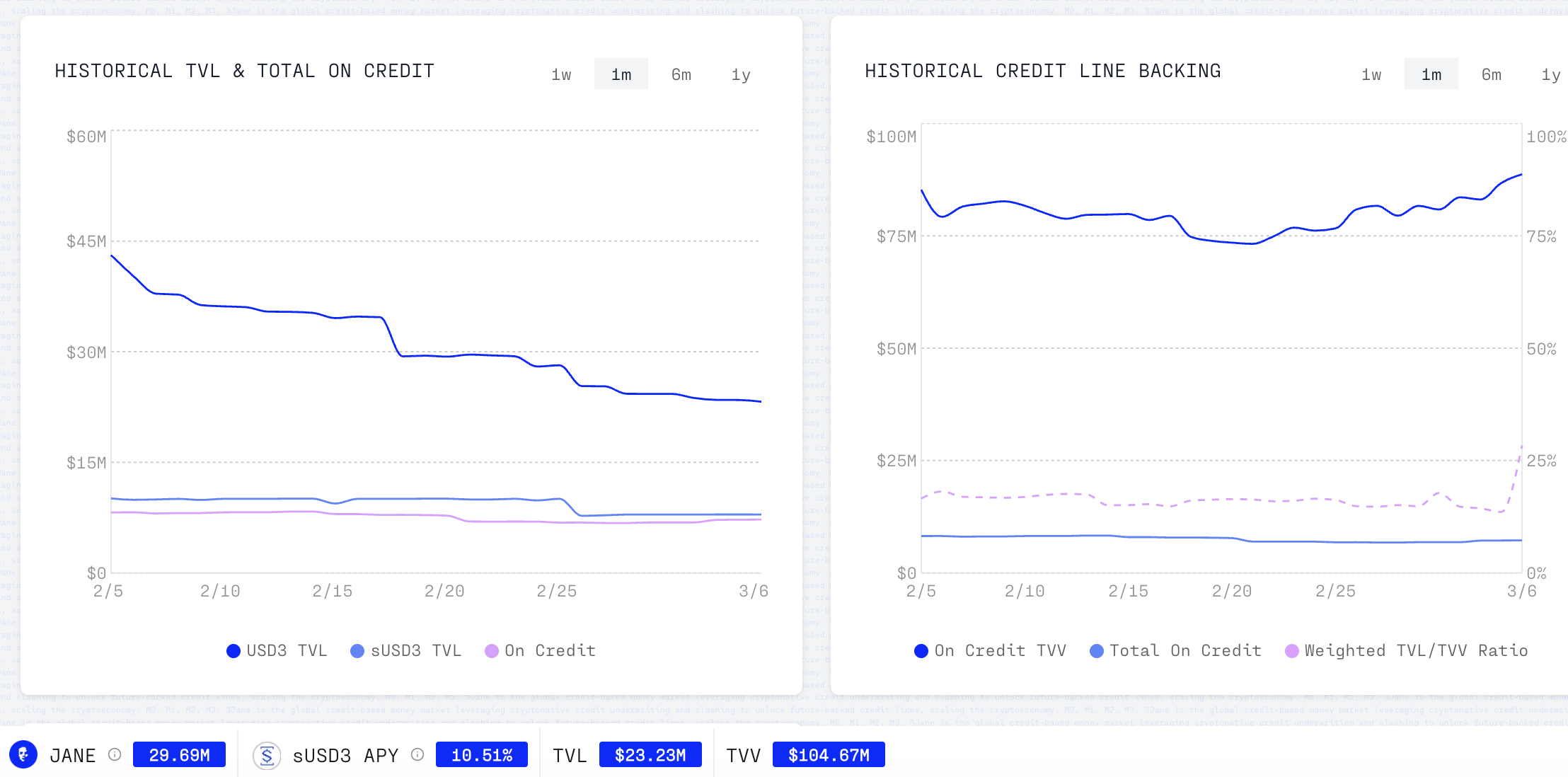
3Jane is still small and cannot compete with Aave or Morpho in scale. But what it is exploring is whether DeFi lending can truly move from collateral-based finance toward credit-based finance. Its core model is to provide unsecured USDC credit lines based on verifiable financial proofs.
Underwriting inputs include credit scores, DeFi assets, CEX/bank assets, and future yield. On the supply side, deposited USDC can form a two-layer structure of USD3 / sUSD3, while idle USDC is first parked in Aave V3’s USDC pool to earn base yield. But when U.S. private credit risk rises, the market will naturally become more skeptical of 3Jane. Because once the credit environment deteriorates, 3Jane no longer faces just a liquidity question. It must also answer:
- Is the first-loss buffer thick enough?
- Is the underwriting actually effective?
- How will bad debt be provisioned and absorbed?
- Is future yield really sufficient to support today’s credit lines?
How Rising U.S. Private Credit Risk Could Transmit into DeFi Lending
If U.S. private credit were to experience rising defaults, widening spreads, or liquidity constraints, the effects would not remain confined to traditional finance. Instead, the repricing of credit risk would move through several layers of the on-chain ecosystem.
Credit-Yield Assets Get Repriced First
The first assets to be hit are unlikely to be pure collateral systems such as Aave or ListaDAO. Instead, the initial shock should land on assets whose underlying yield is directly tied to off-chain credit risk. As defaults, write-downs, and liquidity problems rise in private credit, the market’s understanding of high-yield dollar products on-chain will shift. They will no longer be seen simply as “high APY on-chain products,” but increasingly as yield instruments that are taking on off-chain credit risk.
Lending Parameters and Collateral Frameworks Are Repriced
If a certain category of credit assets enters on-chain lending collateral systems, the shock will then propagate further into LTVs, borrow caps, liquidation discounts, and risk parameters. Shared-pool systems will become more conservative. Isolated-market systems will allow risk to remain localized. CDP systems will become more focused on whether collateral ratios and liquidation thresholds are sufficiently conservative. This is where the institutional differences of systems such as Morpho and ListaDAO become more visible, especially in how they distribute and contain heterogeneous risk through market isolation or curator-based structures.
Capital Preference Shifts from Yield to Safety
When the off-chain credit environment deteriorates, on-chain capital will rebalance. Funds will rotate out of credit-sensitive yield pools and into:
- highly liquid collateral lending pools,
- standardized stablecoin financing pools,
- and CDP systems with more direct collateral logic.
This means that Aave, Spark, Compound, and ListaDAO may all benefit in relative terms. By contrast, Maple and 3Jane would likely need to offer either higher yields, stronger transparency, or thicker loss buffers in order to keep attracting capital.
Repricing of Different DeFi Lending Models Under This Scenario
If private credit risk begins to rise in the United States, DeFi lending protocols will not all react in the same way. Their exposure to off-chain credit risk, their collateral models, and their structural design will determine how the market reprices them.
Aave, Spark, Compound
The core risks of these protocols remain volatility in on-chain collateral prices and liquidation efficiency, rather than off-chain borrower credit losses.Therefore, when U.S. private credit risk rises, they increasingly resemble the high-quality collateral layer on-chain, absorbing part of the capital that exits credit-sensitive assets.
Morpho
Morpho’s value is not that it is necessarily safer in every case, but that it is more structurally suited to handling heterogeneous assets in heterogeneous markets.If DeFi continues bringing in RWAs, special collateral types, and customized risk buckets, then architectures like Morpho will likely have stronger advantages than unified shared-pool designs.
Maple
Maple is the closest on-chain transmission layer to traditional private credit.So it is also the most directly affected.Once the market reprices U.S. private credit, the valuation logic of protocols like Maple will begin to resemble that of a credit fund, rather than that of a high-growth DeFi protocol.
3Jane
3Jane’s strength lies in its attempt to let DeFi experiment with credit expansion itself. But, during a phase of rising credit risk, it is also one of the easiest models to question.
The market will focus on:
- whether the underwriting is credible,
- whether the first-loss buffer is sufficient,
- and whether the protocol can survive through a real bad-debt cycle.
Scenario Analysis
The following scenarios outline how the ecosystem could evolve across three different levels of stress, ranging from mild credit tightening to systemic contagion.
Scenario 1: Mild Deterioration
If U.S. private credit continues to see more write-downs and refinancing pressure, but does not enter systemic panic, then the most likely on-chain consequences are:
- slower growth in credit-sensitive yield assets,
- continued strength for Aave, Spark, and Compound,
- relative stability for CDP systems such as ListaDAO,
- and higher required risk premia for Maple and 3Jane.
Scenario 2: Clear Contagion
If write-downs and defaults among private credit funds expand more visibly, then on-chain markets will begin drawing a much clearer distinction between:
- collateralized lending systems with fast exit paths,
- and yield markets that require longer holding periods and depend on credit recovery.
In this scenario, Maple and 3Jane would face significantly greater pressure. Morpho’s isolated-market architecture would gain relative advantages. Whether ListaDAO benefits would depend on whether the market becomes more biased toward stablecoin financing systems with explicit collateral and explicit liquidation logic.
Scenario 3: Systemic Shock
If private credit risk continues transmitting into the broader credit market, then risk assets as a whole will come under pressure. Even so, mainstream DeFi lending today remains fundamentally different from 2022 in one key respect: it is now more heavily built around overcollateralization, transparent parameters, and on-chain liquidation. So the more likely outcome is violent deleveraging, rather than a black-box-style credit collapse. The more dangerous structures are those that package credit risk as if it were a liquidity product, while the actual recovery mechanism remains opaque, as well as structures with insufficient liquidity that become vulnerable to deleveraging liquidations, such as USDX/XUSD.
Conclusion
Rising U.S. private credit risk will not hit all DeFi lending models evenly. Instead, it is likely to accelerate the sector’s shift from competition over liquidity toward competition over credit stratification.
Within this framework:
- Aave, Spark, and Compound represent the on-chain high-quality collateral layer;
- Morpho represents an institutional architecture better suited to carrying heterogeneous credit risk;
- Maple represents the institutional credit layer most tightly linked to the traditional private credit cycle;
- 3Jane represents the most imaginative, but also the most questionable, layer of natively on-chain unsecured credit.
Once U.S. private credit enters a more visible phase of default contagion, the key question for DeFi lending will no longer be who can lend more. It will be who can better price credit, isolate risk, and absorb bad debt.